Manufacturing

AI Driven Automated Video Monitoring For Manufacturing

VisionBot is a platform that leverages the scalability and availability of cloud services to offer Visual AI solutions. Visionbot helps businesses get the most out of their visual content, thereby deriving powerful insights and driving decision making. Designed as a cloud based Software-as–Service(SaaS) model, Visionbot lets you start using the system with minimal investment by using existing CCTV cameras. Visionbot can also be offered as an on-premise service in Hybrid/Private Cloud/Data Centre for enterprise requirements. It is an adaptive platform and learns on its own. Same time, Visionbot also expects you to provide outcomes, as in, what and how you would want Visionbot to report what it observes, depending on the use case.

AI-in-manufacturing
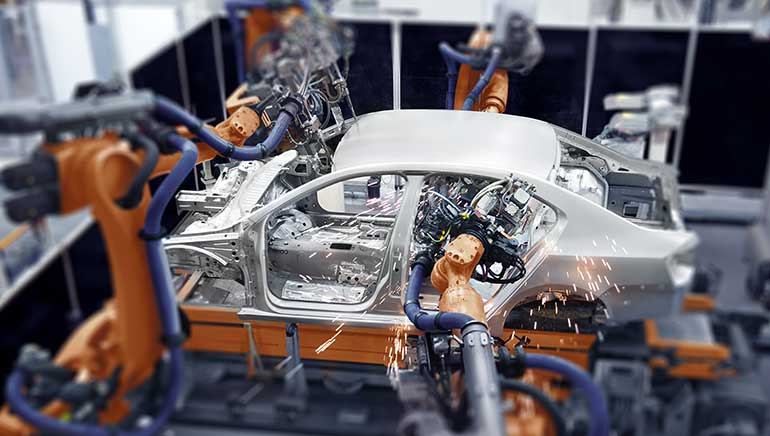
Visual AI can be used in manufacturing for quality assurance by automatically inspecting products for defects or deviations from specifications. This can be done using techniques such as image processing and deep learning to analyse images or videos of the products. Visual AI can be used in manufacturing for quality assurance by automatically inspecting products for defects or deviations from specifications. This can be done using techniques such as image processing and machine learning to analyse images or videos of the products. This can help to improve the accuracy and efficiency of the inspection process and reduce the need for human inspection. Some examples of computer vision application in manufacturing include:

Identifying defects on a surface of a product
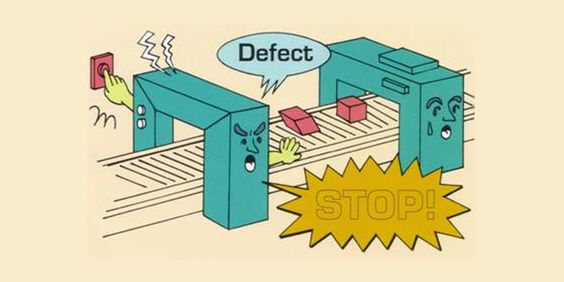
Visual AI can be used to identify defects on a product surface by using techniques such as image processing, pattern recognition, and machine learning. This can be done by capturing an image of the product surface, pre-processing the image to remove noise and improve contrast, then using algorithms to detect any anomalies or defects that deviate from a standard pattern. Some common defects that can be detected include scratches, cracks, chips, and blemishes. The results can be used for quality control and to improve the manufacturing process.
AI-defect
motherson-sumi

Checking the alignment and orientation of components

Visual AI can be used to check the alignment and orientation of components by using image processing and computer vision algorithms. This can be done by capturing an image of the components and using algorithms to analyse the image and determine the relative positions and orientations of the components. Some common algorithms used for this include feature detection, template matching, and edge detection. The results can be used for quality control and to improve the manufacturing process by ensuring that components are properly aligned and oriented. This can help to reduce defects and improve product reliability.

Measuring dimensions and tolerances

Visual AI can be used for measuring dimensions and tolerances by analyzing images of objects and using algorithms to extract dimensional information. This can be done using techniques such as edge detection, blob analysis, and pattern recognition. The system can be calibrated using a known reference object, and then used to measure the dimensions and tolerances of other objects. The results can be used for quality control, to ensure that products meet specified dimensional requirements, and for process improvement, by using the data to optimize production processes. The use of computer vision in measuring dimensions and tolerances can increase accuracy and efficiency compared to manual measurements.

Monitoring assembly processes for compliance with standard procedures

Computer vision can be used to monitor assembly processes for compliance with standard procedures. This is done by using cameras to capture images and videos of the assembly process, and then using computer vision algorithms to analyse the images and videos in real-time. These algorithms can be used to detect deviations from standard procedures, such as incorrect assembly sequence or incorrect parts being used. This information can then be used to alert operators to take corrective action or to record non-compliant actions for further analysis and improvement of the process.

Tracking and identifying products throughout the manufacturing process
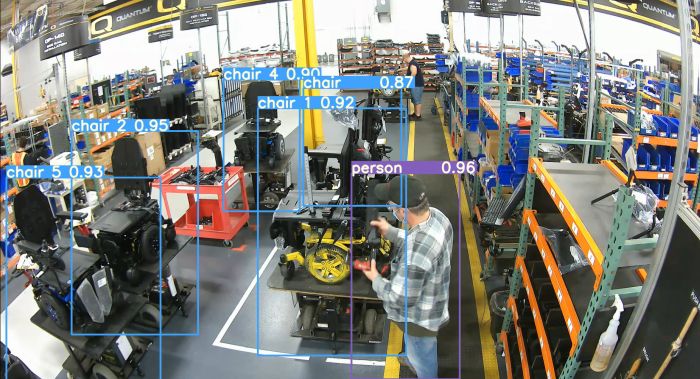
Computer vision can be used for tracking and identifying products throughout the manufacturing process. This is done by using cameras to capture images and videos of the products at various stages of the manufacturing process, and then using computer vision algorithms to analyse the images and videos in real-time. These algorithms can be used to identify individual products and track them as they move through the manufacturing process. This information can then be used to ensure that each product is processed correctly, and to track the location of products within the manufacturing facility. Additionally, computer vision can also be used to verify product quality, by analysing images of each product to ensure that it meets specified quality standards.
“Visual AI cloud solutions can bring state-of-the-art deep learning to solve industrial computer vision problems, utilizing the innovative AI methods built on top of the modern cloud technology stack”*
Automates
Visual Monitoring

1

Workflow Automation and Reporting

2

Improved Accuracy of Actionable Object Data

3

IMPLEMENTATION

VisionBot can be implemented in two ways

On Premise Edge Computing

We recommend the On Premise Data Center mode for installations that have or likely to add a large number of cameras. Cameras are easily installed either through our partners or by third party service providers. VisionBot works with most modern IP CCTV camera systems subject to adequate ambient light conditions.

VisionBot server(s) will be installed at local Data Center over a network either cabled or over wide area wifi.
On Premise Edge Computing

Cloud Based Implementation

For smaller sites or temporary sites we recommend an asset light implementation of VisionBot.

In this case there is no need of installing servers and data centre operations. Cameras can be directly interfaced to VisionBot cloud servers through appropriate internet routers. There is no upfront investments except cameras and switches. This configuration is highly popular and effective as it can also connect multiple sites that provides senior executive 24X7 access to field data and visuals.

VisionBot is a scalable system that can be used to analyze hundreds of camera feeds. It is cloud based thereby ensuring that Enterprise staff can access the data and information anywhere and anytime. Simultaneous monitoring of hundreds of cameras across multiple locations also provides deep insights for strategic planning, resource management and improves operation efficiency of organisations.